Peace and justice in The Hague: how to visit the Peace Palace, the ICJ and the ICC
September 3, 2026 · by Robin Lenskens
You can visit the Peace Palace visitor centre for free any day it is open, walk up to the gate and attend a public hearing of the International Court of Justice with nothing but a passport, and sit in the public gallery of the International Criminal Court without a reservation. What you cannot do is walk into the Peace Palace itself: interior tours run only on a handful of days a year when the courts are not sitting, and they sell out. This guide sets out what each institution allows, how to plan a half day or a full day around them, and why this small city became the legal capital of the world.
Why is The Hague the city of peace and justice?
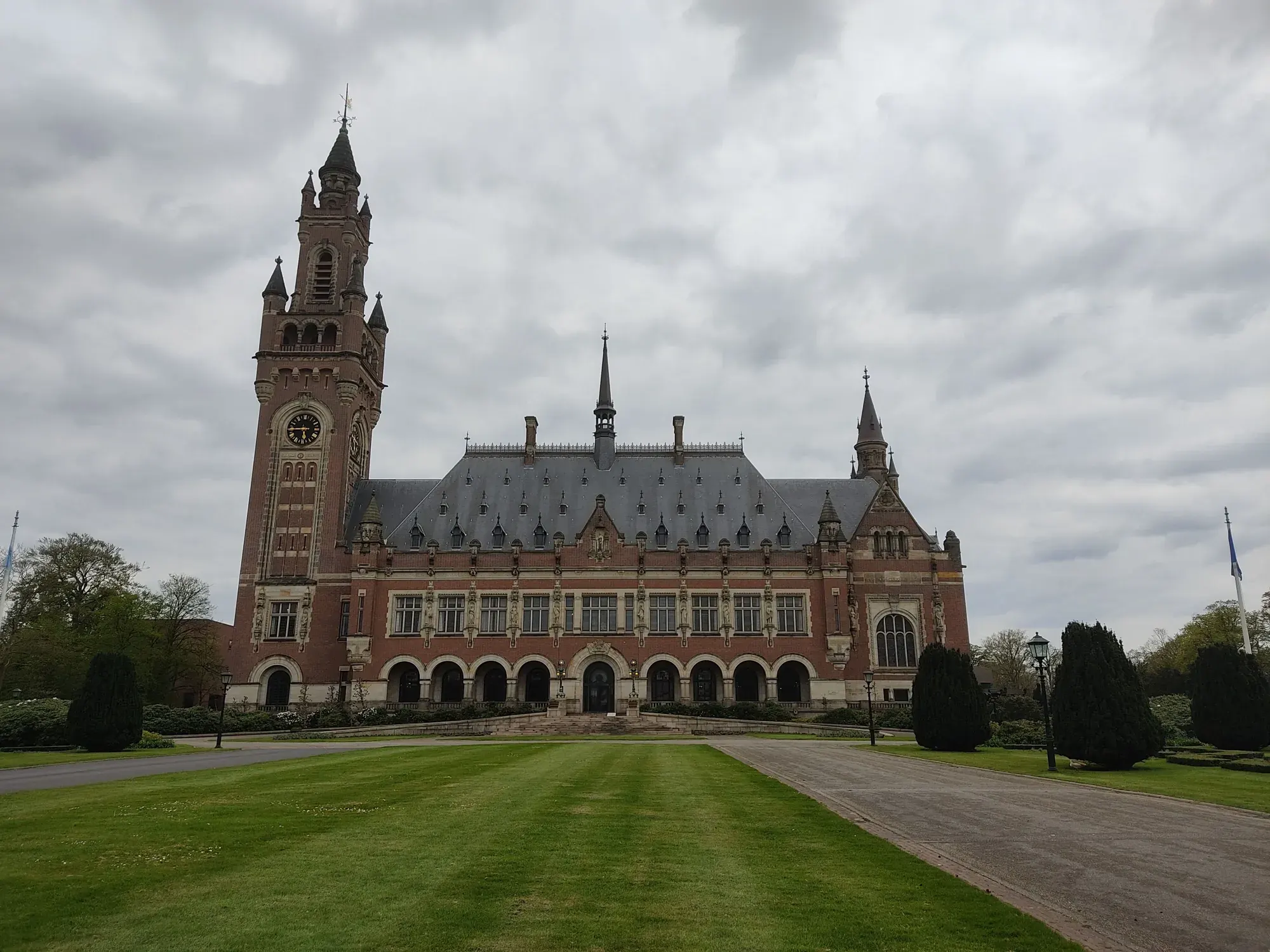
Because of two conferences and one donation. In 1899 and again in 1907 the world’s governments met in The Hague, at the invitation of the Russian tsar and with the Dutch as hosts, to discuss disarmament and the peaceful settlement of disputes. The 1899 conference created the Permanent Court of Arbitration, the first standing body for settling disputes between states. It needed a home, and the Scottish-American steel magnate Andrew Carnegie paid for one: the Peace Palace, designed by the French architect Louis Cordonnier and opened in 1913. The Carnegie Foundation still owns and runs the building.
Everything since has followed that precedent. The League of Nations put its court, the Permanent Court of International Justice, in the palace in 1922; the United Nations replaced it with the International Court of Justice in 1946; the Yugoslavia tribunal came to The Hague in 1993, the Organisation for the Prohibition of Chemical Weapons in 1997, and the International Criminal Court in 2002. The city now describes itself as the international city of peace and justice, and the label is accurate: no other city hosts as many courts.
What is in the Peace Palace?
Four institutions share the building on the Carnegieplein:
- The International Court of Justice (ICJ), the principal judicial organ of the United Nations, which settles legal disputes between states and gives advisory opinions to UN bodies.
- The Permanent Court of Arbitration (PCA), the 1899 body, which administers arbitrations between states, companies and individuals.
- The Hague Academy of International Law, which runs summer courses in the palace grounds.
- The Peace Palace Library, one of the largest international law libraries in the world.
The palace is a working courthouse, which is why access is limited. The garden, the Great Hall of Justice and the gifts from member states (the Japanese tapestries, the Russian vase, the Swiss clock) are what the inside tour shows.
How do I visit the Peace Palace?
The visitor centre: free, no booking
The visitor centre stands beside the main gate and is the one part of the site that is always open to the public. Entry is free (donations welcome), and it holds an exhibition and film that take 35 to 40 minutes, with an audio tour in ten languages including English, German, French, Spanish and Italian. Opening hours from the Peace Palace visitor centre page:
| Period | Days | Hours |
|---|---|---|
| April to October | Tuesday to Sunday | 10:00–17:00 |
| August | Daily | 10:00–17:00 |
| November to March | Tuesday to Sunday | 11:00–16:00 |
Closed on Christmas Day, Boxing Day, New Year’s Day and King’s Day. From the visitor centre you also get the best view of the building and its gardens through the railings.
Inside the Palace tour: selected days, book early
The Carnegie Foundation runs guided tours through the palace on several days a year, only when neither court is in session. Tours last 50 to 60 minutes, cost €16.50 per person (free under 8), are given in Dutch or English, and take a maximum of 20 people, which is why they sell out. You need a valid passport or EU identity card at the gate, you pass through a metal detector, and bags and phones go into a locker. Wheelchairs and pushchairs have limited access, and mobility scooters are not admitted. Tickets are non-refundable. Dates are released on the Inside the Palace tour page; if you are planning a trip around this, check it as soon as your dates are fixed.
Around the Palace tour
On days when the inside is closed, a guided walk around the grounds and garden is offered at €12.50, also 50 to 60 minutes and a maximum of 20 people. It involves many steps in the garden and is not suitable for wheelchairs. Details on the Around the Palace page.
Can I attend a hearing at the International Court of Justice?
Yes, and it is the most direct way into the Peace Palace. ICJ public hearings take place in the Great Hall of Justice and a number of seats are set aside for the public, first come, first served, after state delegations and diplomats. The rules, from the ICJ’s attending a hearing page:
- No reservation or registration is possible. You turn up at the Peace Palace gates with a passport or identity card at least 30 minutes before the sitting starts.
- You pass a metal detector, hand over your identity document in exchange for an access pass, and get it back on leaving.
- Large bags, backpacks and electronic equipment are not allowed, and photography is prohibited.
- You are admitted for the hearing only, not to look around the building, and you are asked to leave immediately when the sitting ends.
- Hearings are in English and French with simultaneous interpretation. Dress appropriately.
Hearing dates are announced on the ICJ website as press releases, usually weeks ahead. Seats for high-profile cases go to people who queue early. For groups, the Court’s Information Department can arrange a briefing on request; the visits section of the ICJ website explains how to ask. The Court also webcasts its hearings, which is what it recommends if you cannot be there in person.
Can I visit the International Criminal Court?
Yes. The ICC is a separate court in a separate building: its permanent premises at Oude Waalsdorperweg 10, on the northern edge of the city near the dunes, opened in 2016. Unlike the ICJ, which judges states, the ICC prosecutes individuals for genocide, crimes against humanity, war crimes and aggression.
From the ICC’s visit page and practical information page:
- The Court is open to visitors Monday to Friday 09:00–16:30, free of charge.
- Public hearings can be attended without prior registration. Sessions are typically 09:30–11:00, 11:30–13:00 and 14:30–16:00, and you can enter and leave the public gallery at any time. Check the hearings schedule before you go, because there are many days with no hearing.
- Visitors must be 16 or over and show a physical photo ID (passport, driving licence or national identity card); digital IDs are not accepted.
- Security screening on entry, a visitor badge to wear, and no photography, filming or recording anywhere on the premises.
- Bus 22 or 23 from the city; free visitor parking on the Van Alkemadelaan.
- Groups, universities and schools can book an information visit with a presentation by staff and a look at a courtroom, via the application form on the visit page.
Give yourself half a day for the ICC, including travel. It is 20 to 30 minutes from the centre by bus and the security queue can be slow on a hearing day.
What else is in the international zone?
The Yugoslavia tribunal building. The International Criminal Tribunal for the former Yugoslavia sat at Churchillplein 1 from 1993 until it closed in December 2017. The building now houses the Hague branch of the UN’s International Residual Mechanism for Criminal Tribunals, which finishes the tribunals’ remaining work. Visitors aged 16 and over can watch public hearings from the galleries with photo ID, and groups of up to 25 can request a free visit at least six weeks ahead, per the Mechanism’s visits page. Hearings are now rare, so check before making the trip.
OPCW. The Organisation for the Prohibition of Chemical Weapons, Nobel Peace Prize 2013, is on the Johan de Wittlaan opposite the World Forum. It does not take individual visitors; organised groups of 15 or more can apply for a visit that includes a presentation and a look at the Nobel medal, as set out on the OPCW visit page.
Eurojust and Europol. Both are in the same district and neither has a public visitor programme. You see the buildings from the outside.
Humanity House on the Prinsegracht, the museum about refugees and disasters that many older guides recommend, closed for good in 2020 after its funding ran out. Do not look for it.
The city centre. The international story is not confined to the zone. The Binnenhof, where the 1899 conference was opened in the Ridderzaal, is under renovation until 2031 but visible from the Hofvijver. The Kloosterkerk on the Lange Voorhout, the Hotel Des Indes where the 1899 delegates stayed, and the embassies along the Lange Voorhout and Zeestraat all belong to the same walk.
A half-day and a full-day programme
Half day (about four hours)
- Start at the Hofvijver for the Binnenhof and the context: the Dutch state, the monarchy, the 1899 conference.
- Walk or take tram 1 up the Zeestraat, past the embassies, to the Peace Palace.
- Visitor centre, exhibition and film (40 minutes), then the view through the gates.
- If a hearing is on and you have queued early, the ICJ sitting; otherwise Panorama Mesdag on the way back, or lunch on the Denneweg.
Full day
Morning as above, with the inside tour of the Peace Palace if your date is one of the tour days. Lunch in the centre. Afternoon: bus 22 or 23 to the ICC for a public hearing or a booked information visit, then back past the Yugoslavia tribunal building and the OPCW to the World Forum area. Finish with a walk down the Lange Voorhout for the embassies and the Kloosterkerk.
For a study group or a professional delegation, the full day works best as a themed private tour with a guide who can carry the thread from 1899 to the ICC and answer questions between stops. That is what we build for universities, law faculties, bar associations and political foundations, and it is also the format for the related themes we are asked for most often: Dutch politics and parliament, the monarchy and the palaces, and the international organisations as a group. Programmes are put together to the group’s brief, and the guide, language and length are chosen to suit. Enquire through our contact page or, for larger groups and multi-city programmes, the groups page on Holland City Tours.
Frequently asked questions
Can tourists go inside the Peace Palace?
Only on a guided tour, on the limited days each year when the courts are not sitting, at €16.50 with a passport at the gate, and tickets sell out. The visitor centre next to the gate is free and open most of the year, and attending a public ICJ hearing gets you into the Great Hall of Justice without a tour.
Do I need to book to attend an ICJ hearing?
No, and you cannot. Public seats are given out first come, first served at the gate, after delegations and diplomats. Arrive at least 30 minutes before the sitting with your passport or ID card, without a large bag or camera. For a well-known case, arrive much earlier.
Do I need to book to attend an ICC hearing?
No. Public hearings at the ICC can be attended without registration, Monday to Friday during the hearing sessions, as long as you are 16 or over and carry a physical photo ID. Check the Court’s hearing schedule first: there are long periods with nothing in open court. Group information visits do need an application.
What is the difference between the ICJ and the ICC?
The ICJ is a UN court that settles disputes between states, for instance over borders or treaties, and sits in the Peace Palace. The ICC is an independent court set up by treaty in 2002 that tries individuals for genocide, war crimes, crimes against humanity and aggression, and sits in its own building on the Oude Waalsdorperweg. They are often confused and are four kilometres apart.
Is there a museum about peace and justice in The Hague?
The Peace Palace visitor centre is the closest thing, with its exhibition and film about the palace and the courts. Humanity House, which covered war and refugees, closed in 2020. For the political side, the Binnenhof visitor centre is also closed during the renovation, so a guided walk is currently the best way to get the story.
How do I get to the Peace Palace?
Tram 1 from Den Haag HS or the city centre towards Scheveningen stops at the Vredespaleis, and it is about a 25-minute walk from the Binnenhof along the Noordeinde and Zeestraat. From Den Haag Centraal, tram 1 from the Grote Markt or a bus from the station; check the 9292 journey planner for the quickest connection at the time you travel.
See The Hague with a Discover The Hague guide
The private walking tour of The Hague covers the political centre and can be extended to the Peace Palace on request, and for a full peace and justice programme, a parliament and politics tour or an international organisations day, tell us the group, the date and the level of detail you want through the contact page. Our guides work in English, Dutch, German, French, Italian and Spanish, and every tour is private to your group.